

The three pieces
Assembly of the kit, warehousing of components and finished kits, and distribution to individuals or locations.
Cost drivers
Dimensional weight, packaging choice and destination mix usually move total cost more than the products inside.
When to outsource
When internal staff are assembling kits, when kits ship to individuals, or when kits must be ready on demand.
Real Bagley work
See the principle in practice
These programs show two different fulfillment shapes: an employee onboarding kit and a curated corporate gift, both requiring coordinated packaging, assembly and delivery.
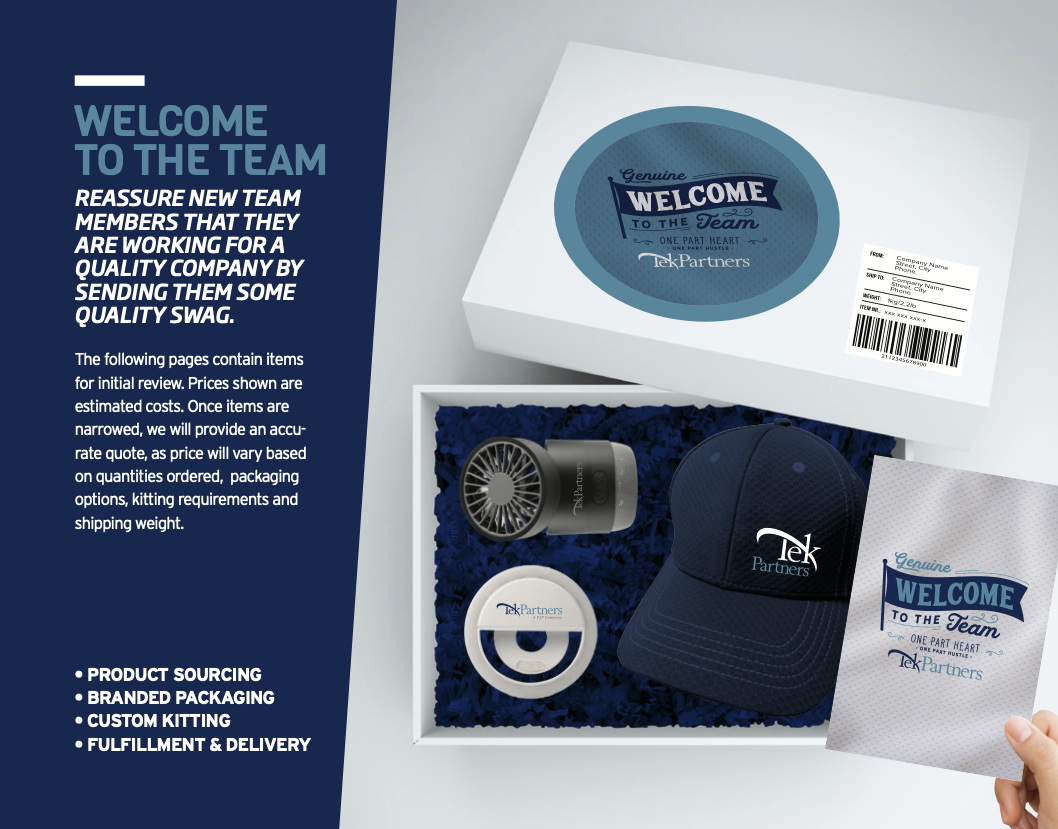
Employee onboarding
Executed program
TekPartners — “Welcome to the Team” Onboarding Kit
An executed employee onboarding kit built around branded packaging, curated products, welcome messaging, kitting and fulfillment — so a new hire's first impression arrives assembled, not improvised.
See this program in Our Work
Corporate gifting & kitting
Executed program
Crescent Solutions — Holiday Gift
A holiday gift built around custom packaging, gift presentation, a branded message and a curated multi-item experience — the unboxing carrying as much of the recognition as the items inside.
See this program in Our WorkDeciding what to outsource
- 1List every kit type you currently assemble and how often
- 2Note who assembles them today and how much staff time it takes
- 3Check whether kits ship to individuals, locations, or both
- 4Set inventory reorder triggers before you run out, not after
- 5Confirm packaging and dimensional weight before finalizing per-kit cost
Planning mistakes to avoid
Pricing the kit without pricing the box
Packaging and dimensional weight routinely move shipping cost more than people expect — a kit that looks affordable item-by-item can get expensive once it's boxed and shipped individually.
No reorder trigger
Waiting until inventory hits zero to reorder components guarantees a gap in fulfillment. A trigger set well before zero avoids the scramble.
Keeping assembly in-house past the point it makes sense
Internal staff assembling kits by hand is fine at low volume, but it quietly becomes a real labor cost once volume or frequency climbs — worth re-checking the math periodically.
Where Bagley changes the outcome
We can run any one of the three pieces — assembly, storage or distribution — or all three, depending on what's actually a bottleneck for you. If assembly is the only pain point and you're fine warehousing finished kits yourselves, we'll say so rather than pitching the full package.
Common questions
- What's the real difference between kitting and fulfillment?
- Kitting is the assembly of individual components into a finished kit. Fulfillment covers storing that inventory and shipping it out — they're often bundled, but either can be handled alone.
- Why does shipping cost so much more than expected for kits?
- Dimensional weight — the size of the box, not just the weight of the contents — is what carriers charge against, and packaging choice has a bigger effect on that than most people assume.
- When does outsourcing assembly actually pay off?
- Usually once internal staff time spent assembling kits, or the need to ship kits to many individual addresses, starts outweighing the cost of having it handled externally.